Showing posts with label invariant manifolds. Show all posts

Friday, 8 April 2011

On a less serious note

So, I realised just a few minutes ago that I haven't written about chaotic attractors in all their splendour. An incredible oversight on my part. These objects are achingly beautiful and intricately complex in form. They arise in phase space (I believe I have covered this) in certain parameter regions of systems. Their fractal geometry means that dynamics is incredibly sensitive on them and while trajectories will follow the path of the attractor (duh! attracting :-) ), there is no predicting which exact part of the attractor it will land on and follow round or ultimately where it will end up. The attractor is fixed, the trajectories are not. A nice succinct explanation is available here.

The one that ties in closest to my work is the Lorenz attractor. The three dimensional system for describing turbulence gives birth to an amazing structure. This attractor is where the 'butterfly effect' expression originated. The attractor itself is geometrically between two and three dimensions and winds itself around two points.


The image (from wiki) shows exactly this. Where the trajectories 'cross' in this two-dimensional visualisation is actually where they layer over each other - manifolds cannot intersect (the unstable manifold exactly describes the attractor). The view is better in 3d. The fractal (Hausdorff) dimension of the attractor is about 2.06.

Other systems with strange attractors are the Rossler system and Henon map. This page gives a nice description and a few images.

As a side note: for those of you who read and enjoyed 'Harry Potter and the Methods of Rationality' or 'Luminosity' I would recommend this strangely named (but you'll understand all too soon) 'Baby Eating Aliens' also from the Less Wrong family and the (there is a theme here, no?) 'Harry Potter and the Wastelands of Time' if you like a bit of complex, epic writing with lots of action and magic!

Enjoy! Also, something to look forward to: I hope to have my poster available for you lot next time I post. :D

Doh! Almost forgot. One of the lecturers at my university (Hinke Osinga) actually crocheted the Lorenz stable manifold! If you want to know how, read this!

Incidentally, my project supervisor is the Bernd Krauskopf mentioned in the article. And yes, it is one of their Christmas decorations. ;)

Tuesday, 15 March 2011

"To err is human"

And guess what?! I'm human. My error this time was such a small thing but it could have had huge consequences if I had not caught it when I had. Actually it would have been far better to have caught it much much earlier but I had no reason to see problems until this point.

I had successfully combined my manifold examination with the Julia Set calculations into one succinct image for each value of the parameter lambda. Nothing twigged until I sat there showing them to my supervisor and he commented that surely the attractors should actually lie within the prisoner set (the points that remained after the iteration). My manifolds also did not line up with the areas they would be expected to. This meant one of two things. Either I had some scaling issue (quite possible with all the jiggling around I had done to get them on the same image) or something was wrong with either side of the analysis (the MATLAB or DSTool code).

Since the DSTool code had been written by someone far more experienced in the area, it was to my code that I turned my attention to find the problem. Took me a while but (as the error rule says) when I found it it was easy to fix. I like to program quite efficiently and as I was testing the absolute value of Z at each iteration I had set
absZ = abs(Z)*abs(Z);
Now instead of square rooting this after I had tested it I had left it which meant that instead of just dividing by the square of abs(Z) at each iteration, it was dividing by the fourth power of abs(Z). Doh!
Thus all my Julia Set images were actually wrong. Re-running the (easily) corrected code showed just how wrong it had been. But it is fixed now and since then I have been working like stink to analyse the correct progression of Julia Sets.

One of the areas that I have now been progressing into was a direct result of the correction. Once the correct maps were generated, I added a further capability to zoom the section around the interesting circle region. This showed that the points within the Julia Set boundary were actually behaving very much like the stable set patterns seen by the PhD student I have been working with. So I have been expanding my analysis to include calculation of the stable set within the Julia Set boundary. This is likely to contribute to connectedness and other behaviours of the map I have already examined.

As far as I understand it, the stable set is the set of points that go to the attractor(s) via the stable manifold due to the existence of a saddle point. Some points, in the course of being iterated, will end up on the stable manifold or on the saddle itself before slowly reaching the attractor. The stable set is all the points back in time that forward in time end up at the stable manifold (thus more pre-image calculations are involved!).

I have calculated this for a few values and they show promising information - I would have inserted images here but the server is rejecting them...
They should help to determine what the hole actually does to the map at least in the limited sense that I am examining it.

Oh, also I would also have shown you the bifurcation progression through lambda but since the server is rejecting my images I won't be. I'll try next week. Sufficed to say that there is a lot going on. I'm not entirely sure I'll find it easy to stick to the 45 page limit. If anyone has any recommendations for that (things that they would find interesting so think should be included) please let me know. :-)

Saturday, 5 February 2011

Weird Manifolds

So this week, I've been using the new software (which is working well now) to calculate the invariant manifolds of the map I've been researching. The best way to think of manifolds are the shapes/curves that the system points hop around on as they iterate under the mapping. There has to be saddle points in the system in order that the stable and unstable manifolds can cross and then be calculated. The calculation to find the manifolds requires tracking backwards in time the path of the saddle point...which shouldn't be possible in a noninvertible system. This is where the weird stuff comes in especially in the case for my map.

For some points, there are no points to track back to or four and for all others there are two possible previous values. Currently the software can calculate two possible values and then for each carries on the path back taking either the 'positive' or 'negative' - whichever is the most likely to be the previous value. It does factor in the no pre-images case but not yet the four possible values. That is part of the work I still have to do this year.

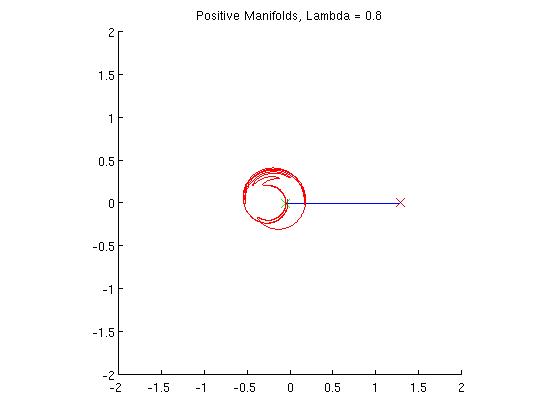
It helps to see some images so here are some I calculated just this week!!


The red line is the unstable manifold and the blue is the stable. The point where they cross is a saddle point in the system and the other cross is the repelling point. I've only shown the positive manifolds (one side of the possible previous values) but the negative manifolds are just the reflection in the x-axis.

Sunday, 30 January 2011

A Pause

There are three very good reasons I haven't really got anything good to talk about this week:

1. I have been wrestling with 32 bit compile on 64 bit architecture in order to get the essential program I need for the next stage of my project installed, compiled and working. It has only just been sorted with some fantastic work-arounds.

2. I have had every afternoon in the last two weeks filled with back to back lectures, mornings with exams and a presentation (which I mentioned last time) as well as work for those said lectures.

3. I have managed to slice open (a bit) the knuckle on my right hand thumb on Wednesday and thus typing, writing and pretty much anything is pretty hard now that I have to do it all left-handed.

Poor excuses, however next week I will dazzle you with fantastic images relating to invariant manifolds. You can read about them if you would like something to do that is more productive than reading this.